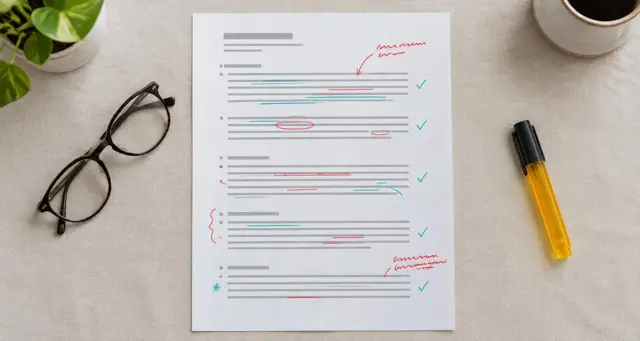

Why tracking mistakes and vocabulary changes progress
Most language students make the same mistakes for months. Not because they cannot learn the correct form, but because nobody keeps track of which mistakes keep coming back. A correction given once, in the middle of a conversation, is easily forgotten by both tutor and student.
Tracking turns corrections into a plan. When you can see that a student has said "I am agree" in four lessons out of five, you know that mistake deserves a focused activity, not another passing correction. When it stops appearing, you have clear evidence of progress to share.
The same is true for vocabulary. Students meet many new words in every lesson. Without a record, most of those words disappear. With a simple list that you review, the useful ones become part of the student's everyday speech.
A simple system that works
You do not need special software. A shared document or spreadsheet per student is enough. The important thing is that it is the same place every time, and that you look at it before each lesson.
The mistakes log
Four columns: the student's sentence, the corrected version, the type of mistake and the date it appeared. Add a tick each time the same mistake appears again.
The vocabulary list
Three columns: the word or phrase, a short example sentence from the lesson and the date. Mark words the student has used correctly on their own.
The review habit
Spend two minutes before each lesson reading the log. Choose one repeated mistake and three words to bring back into the conversation.
Example mistakes log
Illustrative entries for an intermediate English learner over four lessons.
- "I am agree with you." "I agree with you." Type: verb form. Seen in lessons 1, 2, 4.
- "He said me that..." "He told me that..." Type: word choice. Seen in lessons 1, 3.
- "I have seen him yesterday." "I saw him yesterday." Type: tense. Seen in lessons 2, 3, 4.
- "Informations" "Information" (uncountable). Type: plural. Seen in lesson 3.
Grouping mistakes by type
Grouping mistakes shows patterns that single corrections hide. Common groups for language learners are tense, word order, prepositions, articles, word choice, pronunciation and false friends.
When one group fills up, plan a short focused activity: five minutes of targeted practice at the start of the next lesson. For example, if prepositions after adjectives keep slipping, prepare a quick set of sentences with "good at," "interested in" and "responsible for."
Bringing vocabulary back
Words stick when the student meets them again in a new context. Before each lesson, pick three words from the list and plan a question that invites the student to use them. If a student learned "to postpone" last week, ask about a time they had to postpone a plan.
Mark words the student uses correctly without prompting. Those are learned. Words that never come back after three reviews may not be useful to this student; it is fine to drop them.
Tracking for other subjects
The same idea works beyond languages. Math tutors can track recurring method errors, such as forgetting to expand brackets. Music tutors can track technique habits, such as rushing quavers. Coding tutors can track repeated bugs, such as type errors when reading input.
In every subject, the question is the same: which mistakes keep coming back, and which have gone?
Using the log to show progress
Every month, compare the log with the month before. Count how many repeated mistakes have stopped appearing and how many new words the student now uses without help. These numbers are concrete progress you can share with the student or a parent.
For conversation students, also look at how much of each lesson the student speaks. A growing speaking share alongside a shrinking mistakes list is strong evidence that lessons are working.
Common mistakes when tracking
- Logging everything. Record the useful mistakes, not every slip. Ten good entries beat fifty minor ones.
- Never reviewing. A log nobody reads changes nothing. Two minutes before each lesson is enough.
- No dates. Without dates you cannot see whether a mistake is fading or repeating.
- Only the rule. Always record the student's actual sentence. It makes the correction memorable.
Tracking without extra work
Write entries during the lesson as corrections happen, then tidy them in the minute after the call. Keeping the log open in a second window makes this almost automatic.
Jotmonk records the lesson, keeps the tutor's and the student's voices apart and drafts notes that include the mistakes made in the lesson, so you can review them and add them to the student's record.
Questions tutors ask about tracking mistakes
How many mistakes should I log per lesson?
Three to eight is typical. Focus on mistakes that affect meaning or that the student is ready to fix.
Should beginners see their mistakes log?
Share a short, positive version focused on what is now solid, with one or two items to work on.
How long should I keep logs?
As long as you teach the student. Remove resolved items into a "Now solid" section so the active list stays short.